
On the 1st of October, 22 arts and culture experts from Finland stepped into the European Parliament visitor centre in Brussels with a shared purpose. Representing member organisations of KULTA ry, the Central Organization for Finnish Culture and Arts Associations, our delegation aimed to make Finnish cultural voices heard where Europe’s future is shaped. As collective action is needed now more than ever, we gathered highlights from our discussions and practical tips for cultural advocacy to continue working for a sustainable cultural sector.
In June 2026, the joint declaration Europe for Culture – Culture for Europe formalised a shared commitment by the EU’s three main institutions to protect, promote and support culture. Yet the currently proposed cuts to Creative Europe’s annual budget for 2027, and to AgoraEU, the future EU programme for culture, media and democracy, for the EU’s 2028-2034 Multiannual Financial Framework (MFF), undermine that commitment and highlight that political recognition alone is not enough. Turning these commitments into meaningful support for artists and cultural professionals requires culture to be firmly anchored in the next EU budget.
As the State of Culture 2026, Culture Action Europe’s biennial report on cultural policy across Europe affirms: recognition was never the finish line, only the starting condition.
Cultural advocacy in practice: 6 key takeaways
1. Show up in person
Build relationships and trust through face-to-face conversations.
2. Get involved early
Be there before any agenda has been set on the table or before policy proposals and priorities are set
3. Offer a ready-made model that fits seamlessly at the EU level
Present concrete, ready-to-use proposals that align with EU-level priorities.
4. Keep advocating actively at home
Maintain an active dialogue with networks where you work.
5. Be precise about what you’re advocating for
Be clear about your goals, define exactly what you want to influence and communicate why it matters.
6. Make the case for a better future
Focus on the opportunities and positive change that you want to create.
The takeaways are based on the lobbying workshop held on 2 October 2026 at the Finnish Cultural Institute for the Benelux office in Brussels, led by Petri Lahesmaa, public affairs consultant, EU affairs entrepreneur and deputy member of the Institute’s executive board.
Cultural advocacy starts with relationships
As the Finnish Cultural Institute for the Benelux sits close to the heart of European decision-making in Brussels, the delegation met with Maria Guzenina, Member of the European Parliament for the S&D Group, substitute member of the Committee on Culture and Education (CULT) and the committee’s only Nordic MEP.
The conversation explored the role of culture in strengthening democracy, reflecting the principles set out in the joint declaration Europe for Culture – Culture for Europe. At a time when misinformation, polarisation and competing interpretations of world events increasingly shape public debate, culture can help build the resilience democratic societies need to navigate uncertainty.
“Without resilience democracy can not thrive. Culture makes you understand humanity. When you read a novel, when you watch a movie, when you see an art piece, it is all part of resilience and resilient people want to have a better world for everybody. Then democracy can actually thrive”
– Maria Guzenina
Cultural participation encourages us to interpret, compare and contextualise information, while exposing us to perspectives that challenge our own, strengthening critical thinking skills. In a political climate increasingly dominated by global crises, the connection between culture, resilience and democracy is an important argument for keeping culture central to public policy.
By building relationships across borders and strengthening Finland’s presence in European cultural networks, the Institute helps foster a sense of belonging to a wider European community and turn shared concerns into collective action. In Brussels, Finnish expertise and perspectives can be brought into EU-level discussions and strategic dialogue between Finnish and European cultural networks can happen.
Read more on how cultural policy is also literacy policy on KULTA ry’s website.
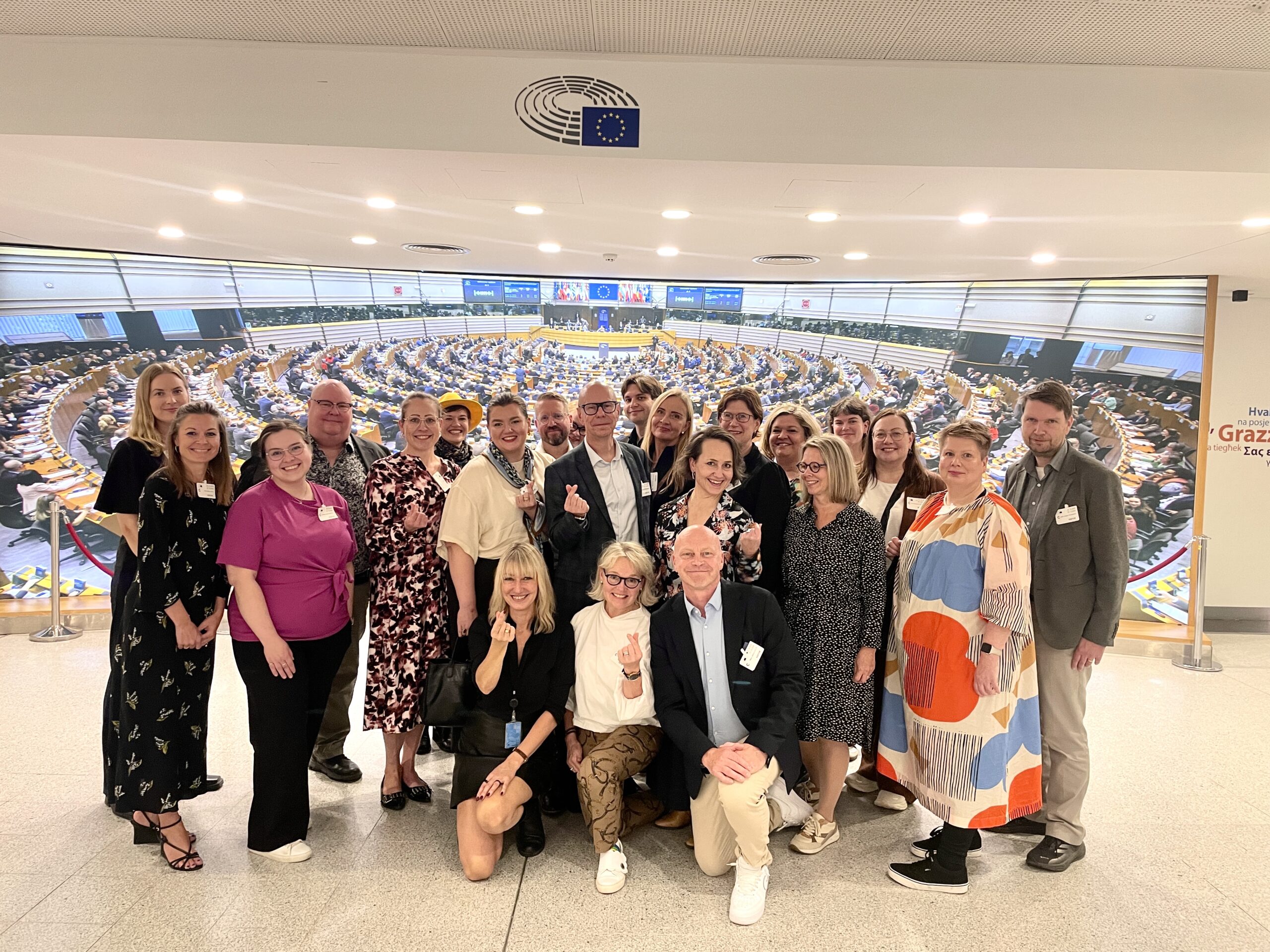
The delegation with MEP Maria Guzenina at the European Parliament Hemicycle, Brussels, Belgium. Photo by Julianna Areva / FCI.
Local realities from the cultural sector in Brussels
During the delegation’s visit to Brussels, we met with Brecht Wille, Institutional Advisor at Bozar – Centre for Fine Arts to gain insights into managing a cultural institution in the Brussels area. The challenges of management were particularly pressing that week, as news of major cultural funding cuts had just broken.
From 2027, the Flemish government plans to cut €47 million from its culture budget, with local and supra-local museums among the hardest hit. Bozar is set to lose all Flemish government subsidies with direct consequences for its cultural programme and fewer opportunities for artists, weakening the cultural labour market.
oKo, the advocacy group, employers’ federation, and network organisation of professional arts organisations in Flanders and Brussels, highlights how the impact of the cuts extends beyond those directly affected because cultural organisations depend on a wider network of local cultural venues, heritage institutions and support organisations. The cultural ecosystem and its interconnected structures as a whole need to be supported to sustain artistic work.
“Culture generates economic activity, employment, international prestige, and revenue, but above all, it creates societal value. (…) Consequently, anyone looking solely at government spending sees only part of the story”, shared Brussels-based interdisciplinary house for arts Beursschouwburg in the lead-up to the Flemish government’s announcement of its cuts, which were originally expected to be 10%.
From Brussels back to Finland: Lessons for cultural advocacy
A wide contribution from cultural professionals is needed as the funding debates go on in the EU as well as Belgium and Finland. Here are few things our delegation took with them to Finland and what we can do going forward:
Follow the negotiations and decisions made on cultural funding. Parliament’s conciliation negotiations about EU’s 2027 annual budget, including funding for Creative Europe with the Council are scheduled for 3–16 November 2026, Meanwhile, negotiations on the 2028–2034 Multiannual Financial Framework (MFF) are ongoing with a special European Council meeting scheduled on 26–27 November 2026. Both of these final budgets are to be agreed on before the end of 2026. The MFF and AgoraEU programme legislation are expected to be formally adopted in 2027, ahead of the new funding period beginning in January 2028.
Turn already existing networks into a collective voice. Connect with networks already doing the work. Follow Culture Action Europe and EUNIC Global for updates on EU cultural policy, advocacy campaigns and opportunities to add you and your organisation’s voice to collective action. KULTA ry and The Finnish Cultural and Academic Institutes work in Finland to advocate on a national level as well as collaborate on EU cultural policy.
Make the impact of cultural institutions even more visible. The more clearly cultural professionals communicate their needs, demonstrate the wider value of their work and build alliances across borders, the harder those realities become to overlook.
Additional resources:
The Finnish Cultural and Academic Institutes are among the 200+ cultural organisations that oppose the proposed cuts to Creative Europe for 2027 with an open letter coordinated by Culture Action Europe.
Read Culture Action Europe’s arguments for reversing the proposed cuts to AgoraEU.
Visit RABKO for cultural policy advocacy in Brussels.
Visit the Culture Policy Room for research and data on cultural policies with focus on Europe.
Visit Cupore for research and data on Finland’s cultural sector to help understand policy developments, support advocacy with evidence, and communicate the wider societal impact of culture to decision-makers.
Read Elävä kulttuuri turvana ja puolustuksena by Aki-Mauri Huhtinen and Elina Knihtilä, published in 2025 in the Finnish national defence journal Maanpuolustus about culture as a form of security and defence.
The trip was organised by the S&D Group in the European Parliament together with Maria Guzenina. The trip’s partners include KULTA ry, the Finnish Cultural and Academic Institutes, and the Finnish Cultural Institute for the Benelux.
The following organisations participated in the trip:
- Suomen Teatterit ry (The Association of Finnish Theatres)
- Circus & Dance Finland
- Finnish Design Info
- Frame Contemporary Art Finland
- Suomen museoliitto ry (Finnish Museums Association)
- Käsi- ja taideteollisuusliitto Taito ry (The Finnish Crafts Organization Taito)
- Suomen Filmikamari ry (The Finnish Chamber of Films)
- Audiovisual Producers Finland – APFI ry
- AV-arkki – The Centre for Finnish Media Art
- Suomen kirjastoseura ry (The Finnish Library Association)
- Lukukeskus Läscentrum ry (The Finnish Reading Center)
- Suomen Kirjailijaliitto (The Union of Finnish Writer)
- Suomen tietokirjailijat ry (The Association of Finnish Nonfiction Writers)
- Sanasto – kirjallisuuden tekijänoikeusjärjestö (Sanasto – The Finnish literary copyright society)
- FILI – Finnish Literature Exchange
- Kansanmusiikki-instituutti ry (The Finnish Folk Music Institute)
- Suomen konservatorioliitto (The Conservatory Association of Finland)
- Communications and Public Relations, Gramex
- Konserttikeskus ry (Concert Centre Finland)
- Suomen lastenkulttuuriliitto (The Association of Finnish Children’s Culture in Finland)
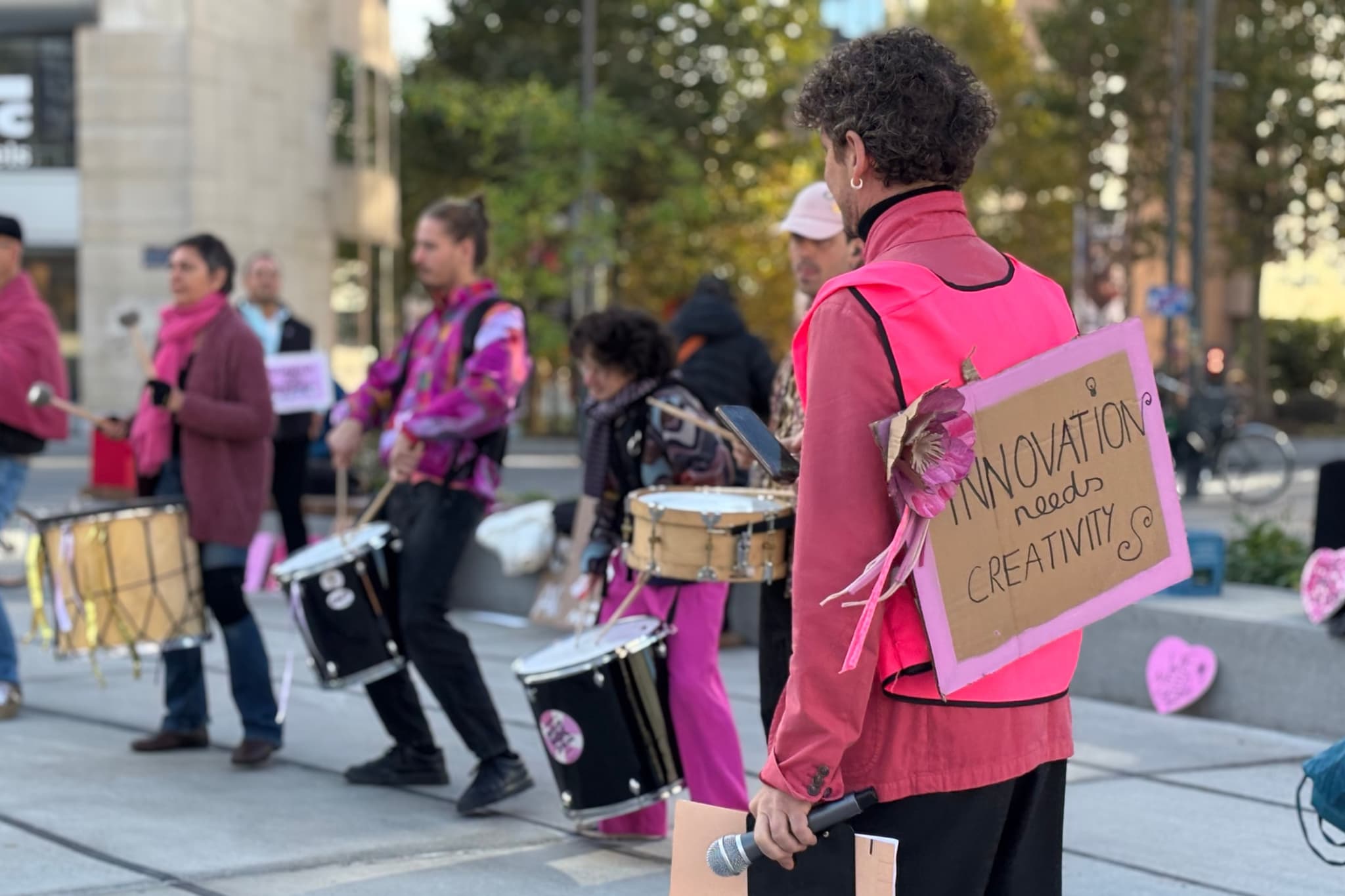
Cover image: AgoraEU demonstration organised by Culture Action Europe in Brussels, Belgium, 2026. Photo by Julianna Areva / FCI.