
In our latest blog post, our resident writer and Programme Assistant, Tilda Forss, shares an overview of reading and writing spaces, and communities in Brussels.
“This overview is not exhaustive, and the scene keeps moving. New spaces and collectives emerge regularly. But the density of what exists here, across languages, disciplines, and neighbourhoods, is the best argument against writing in isolation I have found.”
Inside Brussels’ literary scene with Tilda Forss
There is a version of being a writer that looks like Hemingway described it: solitary, near-masochistic, a person alone at a typewriter, bleeding onto the page. Then there’s the one Camus gestured towards when he argued that a writer’s purpose is to keep civilisation from destroying itself – a fundamentally relational one. Language is a contract – words mean what we have communally agreed for them to mean – so, yes, writing is a task possible, and often performed, in isolation. But writing without community, infrastructure, feedback, over time, is, I tell you, much, much harder.
I have been writing daily since 2021, and one of the things that has kept me going is the support and knowledge of writers. They are everywhere, including, in surprising density, in Brussels.
Brussels occupies an unusual position in European literary culture. Its linguistic plurality of French, Dutch, and a dense international overlay has historically made it both a refuge and a meeting point for writers. From Victor Hugo to Paul Verlaine to Charlotte Brontë, the city has long attracted those who needed distance from their own contexts. That tradition continues today, expressed not in grand monuments but in a solid network of bookshops, cultural institutes, small workshop collectives, talks, debates, festivals, and open stages scattered across the city’s many neighbourhoods.
What follows is an overview of the reading and writing spaces and communities I have used, been enthralled by, or remain curious to attend. I offer these to you to make your texts less lonely, more inspired, and at large, perhaps, better.
Passa Porta
First off: Passa Porta, the International House of Literature, is a multilingual meeting place in the heart of Brussels for anyone curious about ideas, texts, and stories. It includes a literary stage, space for workshops, a flat for a writer in residence, a multilingual bookshop, and, as of April this year, an expanded English language bookshop next door. Every year, Passa Porta receives up to nine foreign writers in residence, creating a working environment suited to both the research and writing phases of a literary project. Beyond residencies, Passa Porta runs an active programme of public events, workshops, and readings, and organises a biennial festival in April that brings together Belgian and international writers, thinkers, and artists. It remains the most prominent institutional home for literary life in the city.
An exciting upcoming event is the Turkish-Croatian writer and political journalist Ece Temelkuran’s talk on the 23rd of April, as part of her tour for her latest book, A Good Crisis (and How Not to Waste It). More information can be found on Passa Porta’s website.
BOZAR – Centre for Fine Arts
BOZAR is best known as a visual arts and music venue, but it regularly hosts literary events, author talks, and cross-disciplinary programmes that bring together writing with other art forms. Recent personal highlights included a powerful and political evening with American-Vietnamese author Ocean Vuong, who – quoting the Roman poet Horace – described the phrase ”nothing human is foreign to me” as a kind of north star for writing in the current climate. He closed his talk by singing a moving rendition of Sam Cooke’s protest song A Change Is Gonna Come. In the autumn, they brought the widely acclaimed poet Anne Carson to Brussels for a performance that included dancers and embroidery art, followed by an intimate interview. These names are just two marks of the international reach BOZAR’s literary programming has achieved. These events are golden to attend when in need of creative rejuvenation.
An upcoming event of interest is a talk with the established Anglophone author Claire-Louise Bennett, taking place on the 2nd of May. More information can be found on BOZAR’s website. For writers interested in the intersection of literature and contemporary culture, BOZAR’s programming is worth following closely.
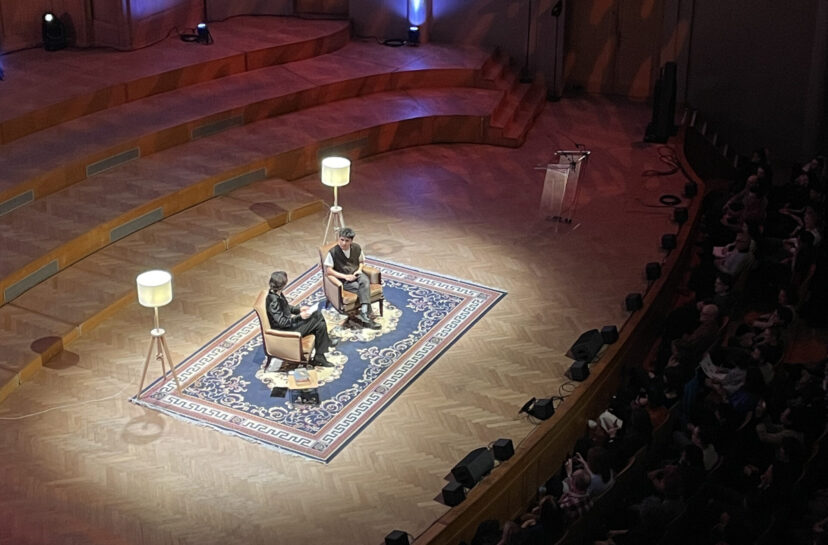
Ocean Vuong’s talk (March 2026) at BOZAR. Photo by Tilda Forss.
Muntpunt
Muntpunt is Brussels’ central public library, a civic gathering space, and home to two recurring writing groups, one in English and one in Dutch, as well as a book club, making it a natural first port of call for writers looking for regular community. More on these below. Overall, the library’s programming is worth keeping an eye on, particularly for Dutch-language literary events and community initiatives.
Brussels Writers’ Circle
Muntpunt is the regular meeting point for the Brussels Writers’ Circle, the city’s longest-standing writing community. Founded in 1997, the group has spent nearly three decades gathering English-language prose writers, poets, playwrights, non-fiction writers, screenwriters, and everything in between. It is the kind of group where you can, for free, bring a half-finished draft, a first attempt, or just yourself, and feel at home.
The format is workshopping-focused: typically two readers per session share work-in-progress and receive constructive, friendly feedback from the group. Sessions take place every first and third Tuesday of the month from 19:00 to 21:00 at Muntpunt (Zinneke 1). The group also meets fortnightly on Thursday evenings at the Falstaff bar (rue Henri Maus 19). Those who want to read can register for a slot in advance by emailing brusselswriterscircle@gmail.com with their name, the length of their piece, and its genre or form. Those who simply want to attend are welcome to turn up without registration. Native fluency in English is not required. As one of the longtime Tuesday session hosts Seth Blaylock puts it:
“We welcome all kinds of writers and all kinds of writing: Prose, poetry, screenwriting… You name it. The wide variety of backgrounds and interests helps the Brussels Writers Circle keep things fresh after all these years.”
I’ve been an active member of the sessions myself this spring and always look forward to the group’s texts, insights, and feedback. More information can be found on Facebook, the group’s Muntpunt site, or their own website. The next session will be Tuesday, the 28th of April.
Het Schrijfgezelschap
Where Brussels Writers’ Circle centres on sharing and feedback, Het Schrijfgezelschap is simply about writing (in Dutch). The group meets every Wednesday evening from 18:00 to 20:00 at Muntpunt, except on public and school holidays. The format is simple: a prompt is drawn from a box, participants have twenty minutes to write in any form, and those who wish can read aloud and receive feedback. Attendance is flexible; some members come weekly, others drop in when they can. Registration per session via Muntpunt.
The Book Club
Other literary events also take place at Munpunt. Kriticos Mwansa is a Brussels-based musician, artist, and activist who founded The Book Club in 2019 as a space for open, honest conversation around literature, culture, and ideas. The concept is simple: you don’t have to have read the book to participate. Sessions are built around discussion, not prior reading, and Mwansa calls his attendees philosophers, from the Greek philosophos, lover of wisdom, because the sessions are designed for anyone moved by curiosity. Many attendees come away wanting to read the works discussed for the first time, which makes it something of a reverse book club.
As Mwansa himself puts it:
”With The Reverse Book Club format, I bring the main subjects of the book to the forefront and, through conversation, the true stories come from the people in the room. Whether it’s in prison, The Merode (a prestigious private members club), a high school, or a simple gathering with friends […] one question has the ability to bring out many different answers and perspectives. No one book club session is the same. That’s my favourite thing about this project.”
The Finnish Cultural Institute for the Benelux collaborated with Kriticos in 2022, bringing the concept to Helsinki in partnership with the Jäbät ja Tunteet community, as part of our Masculinities programme. In Finland, he organised a session on masculinity centred on bell hooks’ The Will to Change. The Book Club now runs monthly sessions across Brussels, Amsterdam, and Berlin and Mwansa hosts regular sessions at Muntpunt. Follow the project on Instagram at @thebookclub.eu or find upcoming sessions at Muntpunt’s website.
The next Muntpunt session will be Thursday, the 16th of April, discussing the book Organizing Your Creative Career by Sheila Chandra. Registration is done through Muntpunt.

The Book Club with Kriticos Mwansa in Helsinki (2022). Photo by Yohannes Henriksson / FCI.
Pianofabriek
Like Muntpunt, Pianofabriek is another central hub that should be on your radar. Pianofabriek is a community arts centre in Saint-Gilles (Rue du Fort 35), housed in a former piano factory, which today functions as a neighbourhood cultural hub. The centre hosts rehearsal spaces, residencies, workshops, and events across disciplines. For writers, it has become something of a local gathering point, home to at least two recurring complementary communities.
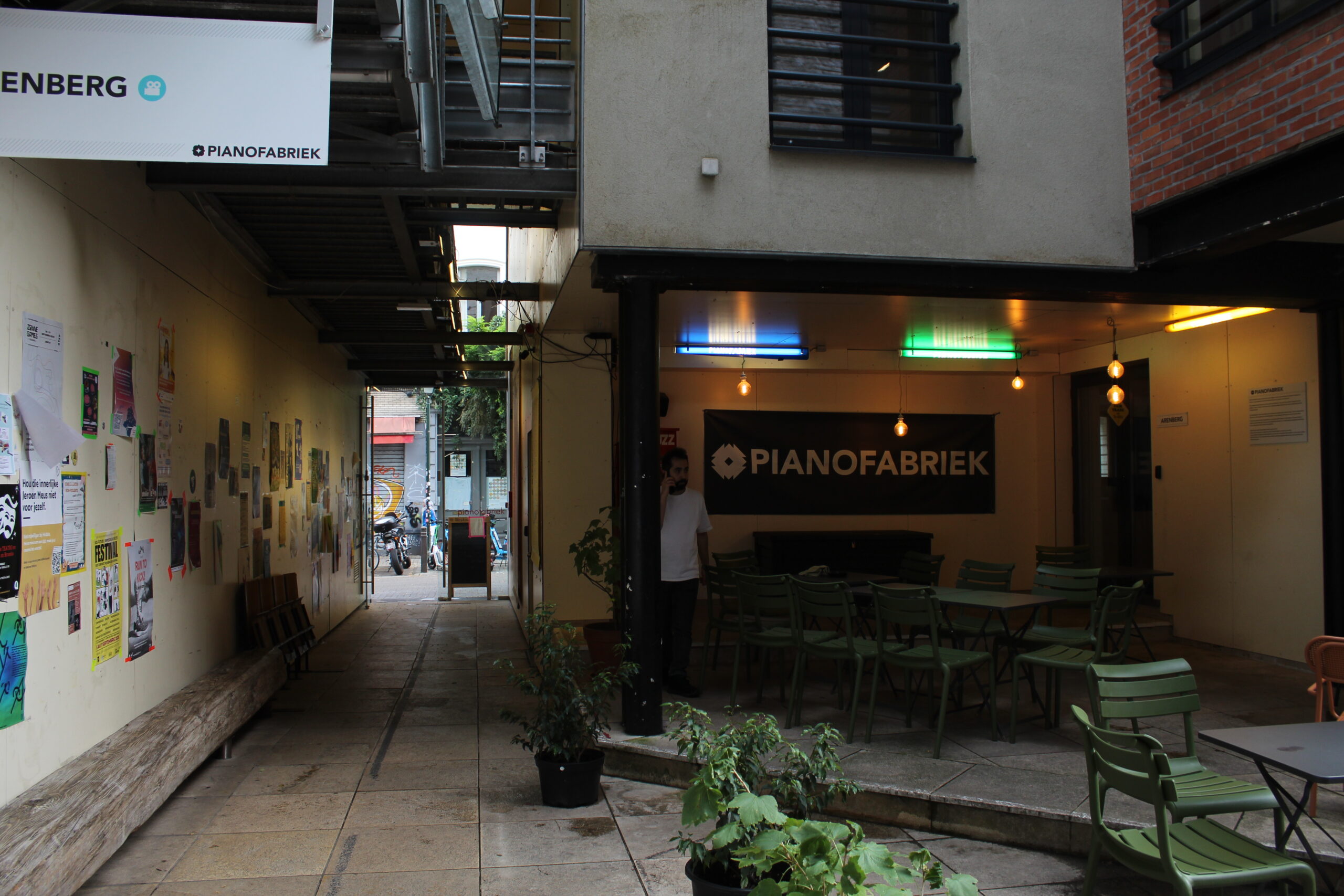
Pianofabriek. Photo by Oscar Arminen.
SpeakEasy Spoken Word BXL
SpeakEasy is Brussels’ multilingual spoken word stage, held every second Thursday of the month at Pianofabriek. It welcomes performers writing in English, French, Dutch, Arabic, Spanish, German, and beyond, and offers both an open mic format and a broader programme of workshops, poetic promenades, and theatrical events — a low-threshold, high-energy entry point into Brussels’ performance writing scene. You can follow their events on their Facebook page or via their website.
Wordcraft Collective – St Gilles Writers’ Group
The Wordcraft Collective runs a community writers’ group rooted in Saint-Gilles, offering a neighbourhood-scale alternative to the larger institutional spaces. Alongside paid workshops, they run two free monthly sessions. A personal favourite is “Write Together”, which takes place every third Saturday of the month from 13:30 to 16:30 at Pianofabriek. Bring a current project or start something new, write alongside others, and stay for a drink afterwards.
“Read Together” is a quieter companion event: an hour of reading in company, followed by conversation, held every first Saturday of the month from 15:00 to 18:00 at La Belladone. Upcoming dates for both sessions in 2026 can be found on the collective’s website.
European Writers’ Salon
Not all of Brussels’ writing communities are rooted in a single neighbourhood or institution – some operate on a larger scale entirely. The European Writers’ Salon is a travelling literary salon whose mission is connecting writers across Europe through online events, pop-up salons in different cities, and an annual gathering that combines open mics, readings, workshops, and panels. Earlier this year, I co-hosted a writing workshop with them at Galerie Bortier to mark their second anniversary, which is the kind of event they do well: low-threshold, genuinely cross-border, and centred on the writing itself. Their next online open mic is today on the 15th of April, free and open to all, booking available via Eventbrite. They also run paid online workshops; the ongoing series, led by writer Mark Bowles, explores writing that resists language across four sessions. More information and upcoming events at saloneurope.org.
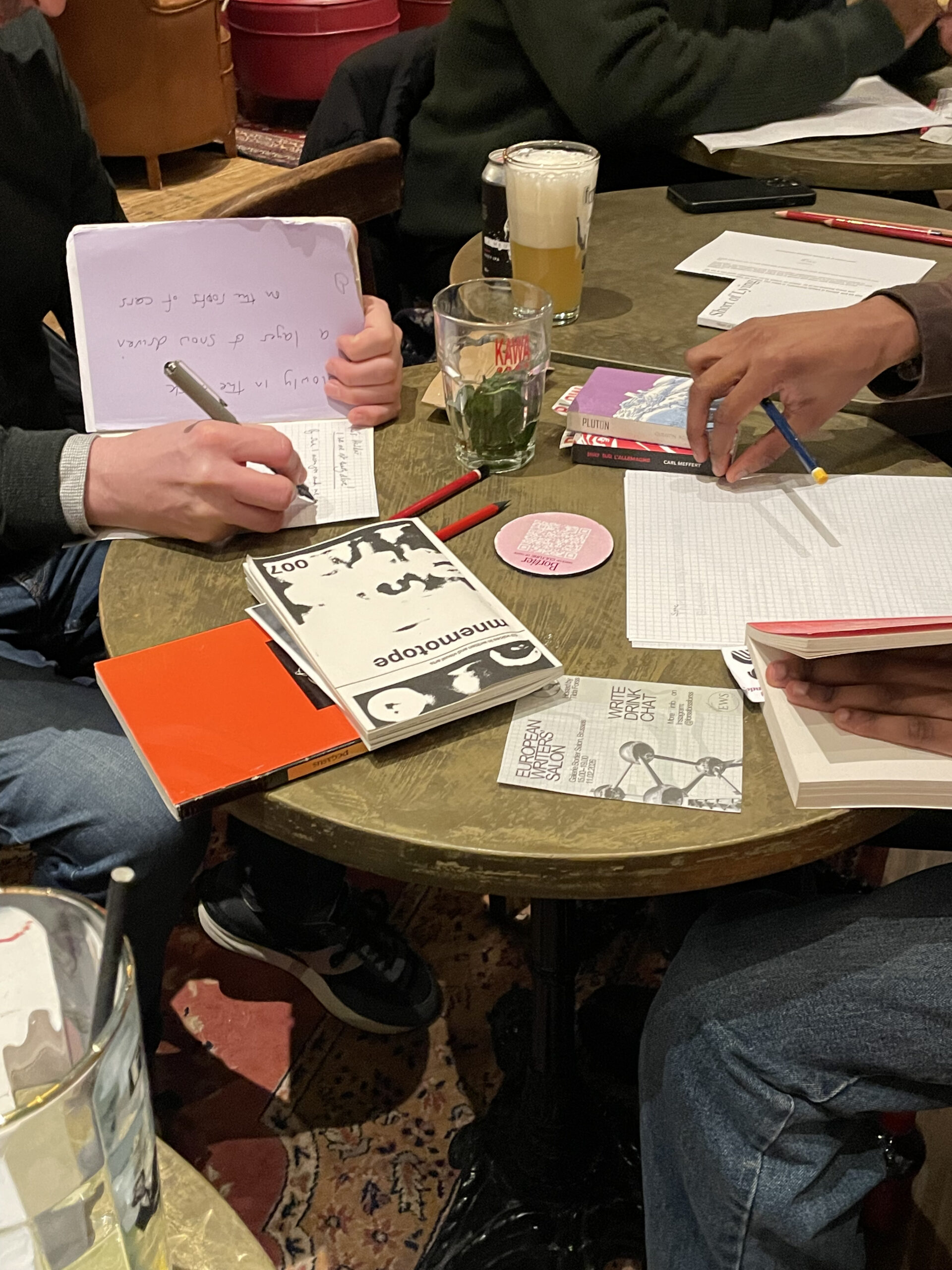
EWS anniversary event Brussels. Photo by Tilda Forss.
PEN Belgium
Another larger and political network that is good to know is PEN Belgium. They operate through two branches, PEN Belgique Francophone and PEN Vlaanderen. Both are affiliated with PEN International, the global writers’ association founded in London in 1921. PEN’s core remit is advocating for freedom of expression and supporting writers at risk, pursued here through literary evenings, public debates, and solidarity actions in collaboration with other cultural institutions. An upcoming example of the kind of work they support: on the 9th of May in Antwerp, Palestinian poets Asmaa Azaizeh and Rasha Hilwi, both living in exile, will perform RIHLA, a poetic dialogue about migration, friendship, and home, organised in collaboration with Passa Porta and the RIHLA project founded by Brussels-based Gazan poet Ahmed Saleh. PEN Vlaanderen will place an empty chair for Palestinian poet Refaat Alareer, killed in 2023. More information at penbelgique.be, pen-vlaanderen.be, and (since they are an institutional power house) passaporta’s website.
Full Circle
For a more private setting, Full Circle is a members club and ideas venue on Chaussée de Vleurgat in Ixelles. Many of their events however, such as the recurring talk series, “Deep Thought”, and their book club run by Italian writer Eleonora Balsano, are open to non-members. The programming sits at the intersection of politics, philosophy, and culture rather than literature narrowly defined, which is part of what makes it interesting. On the 20th of April, for instance, political philosopher Lisa Herzog will discuss her latest book, The Democratic Marketplace, on embedding democratic values in economic life. In literature, as in the rest of Brussels, politics is omnipresent. Full programme at fullcircle.eu.
rile*
For a younger and more experimental entry point into Brussels’ literary scene, rile* is a small bookshop and project space on Rue des Commerçants with a particular focus on poetry, theory, choreography, and artist writing. The name derives from the base word for silence in Láadan, a feminist constructed language developed by Suzette Haden Elgin in 1982 and featured in her Native Tongue trilogy – which tells you something about the kind of space it is. rile* organises performances, readings, launches, and meetings, and functions as one of the more singular literary venues in the city. An upcoming event worth noting: on the 25th of April, writer and translator Jen Calleja launches the French edition of Goblinhood: Goblin as a Mode, a hybrid of essay, autofiction, poetry, and what she calls goblin theory, with readings in French and English followed by a conversation. More information on rile’s website.
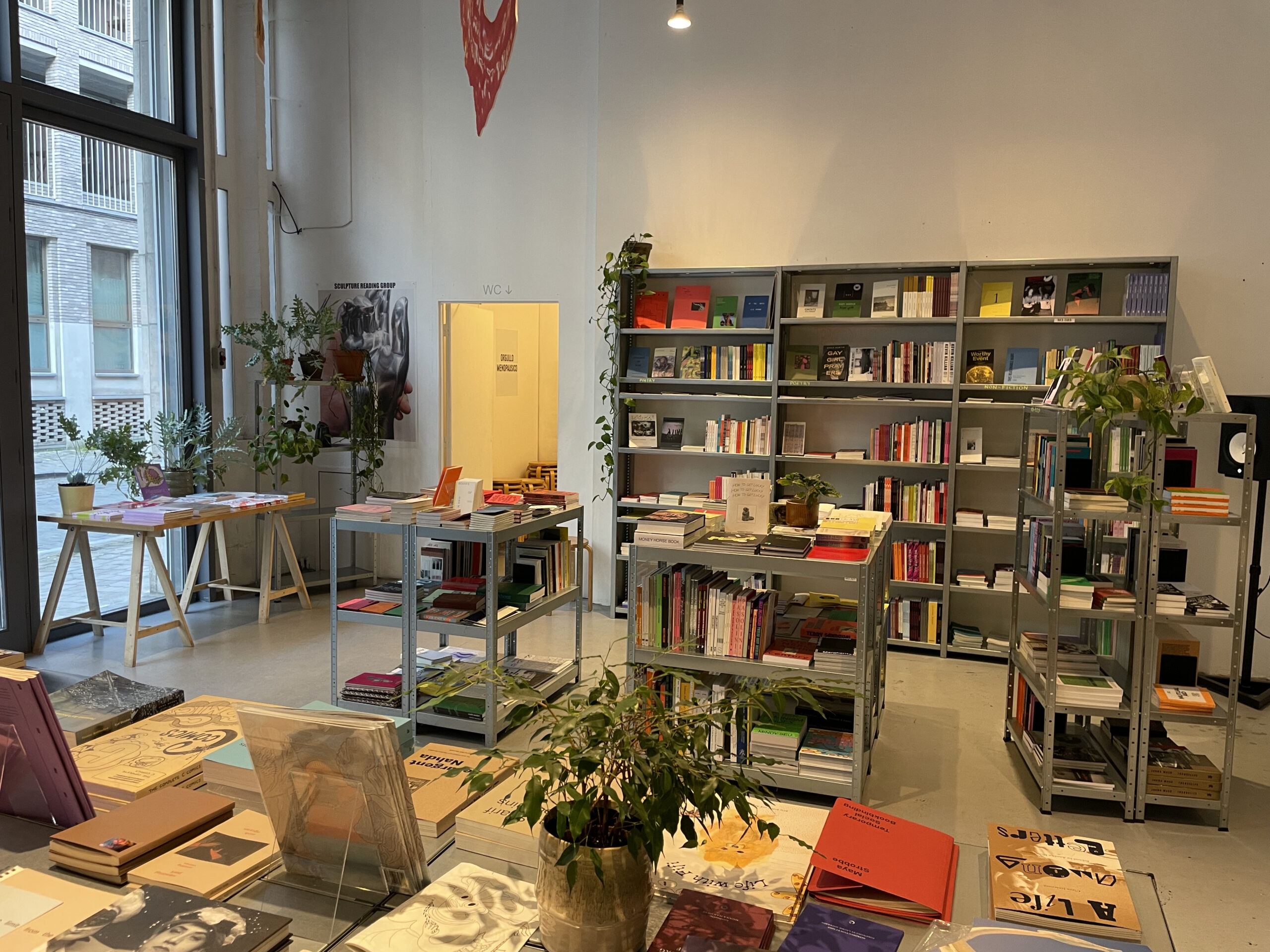
The rile* bookshop. Photo by Tilda Forss.
bog bodies press
Worth knowing in the same breath as rile* is bog bodies press, an independent Brussels-based press founded in 2023 by Lilou Angelrath and Réiltín Ní Aodhagáin, two writers who started the project from their thesis research on publishing and never quite stopped. Their guiding conviction was that stories belong to people, not to literary institutions, and their publishing practice reflects it: they work with transcribed audio, translation, and writing in all its forms, and have so far published the work of more than 300 people, from 28 different countries, most of them for the first time. Their events, held in Brussels and beyond, tend to feel more like gatherings than launches – the kind of evenings where the boundary between reader and writer quietly dissolves. Every so often they for example organise wonderfully low-key storytelling dinners where people (whether they love to write or avoid it at all costs) can eat, drink, and tell stories – theirs or stolen, true or made up. Keep an eye on their upcoming events at bogbodiespress.com and on their Instagram.
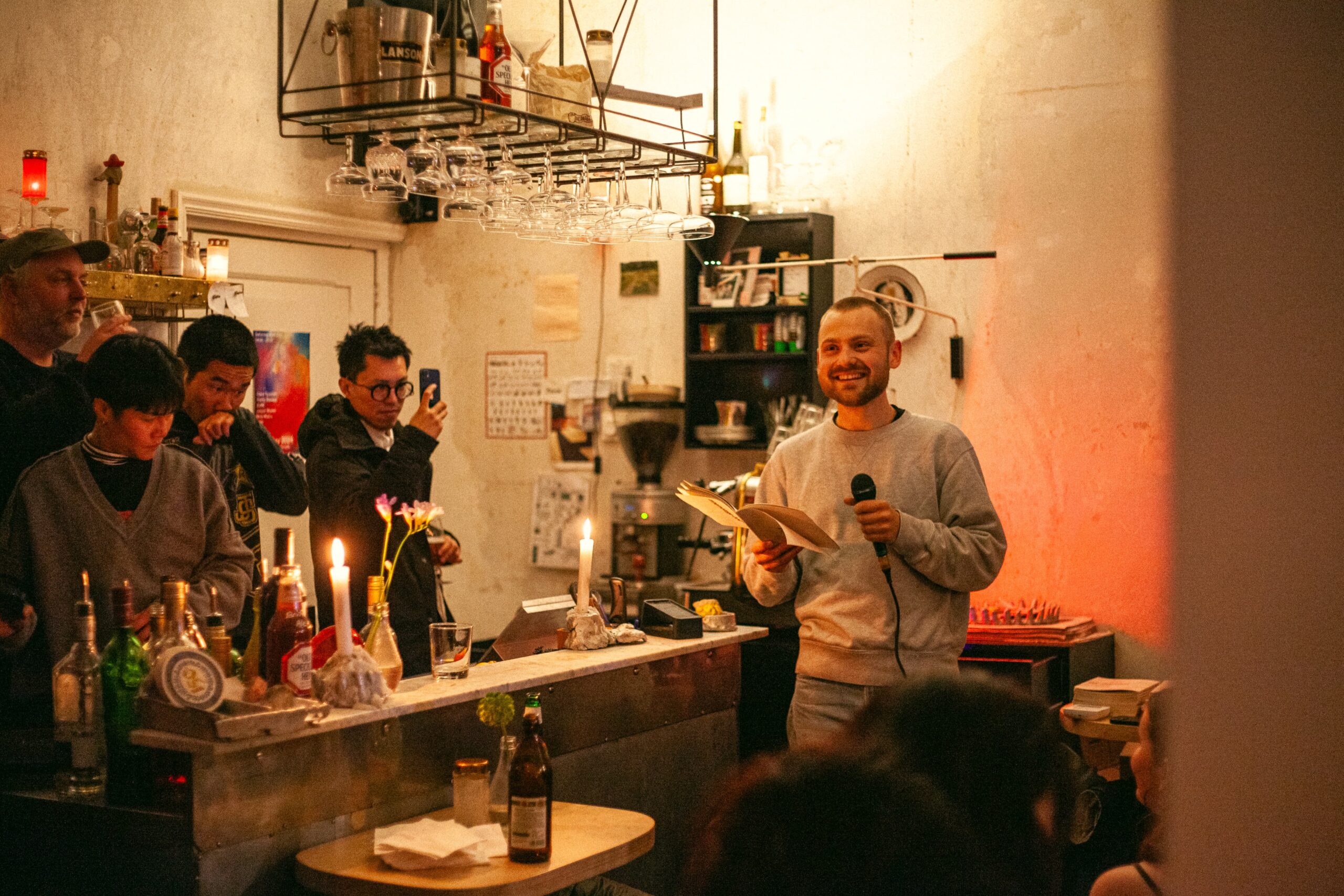
A reader at a bog bodies event. Photo by Luca Monner.
Festivals
Beyond the recurring communities and venues, Brussels also has a festival calendar worth marking. The most significant is the Passa Porta Festival, a biennial event that brings around 100 national and international writers, thinkers, and artists to Brussels for four days of readings, performances, and debates. The next edition will be in 2027. Another big one is Foire du Livre de Bruxelles, held annually at Tour & Taxis in late March, the city’s largest book fair. It is francophone in focus but broad in its programming.
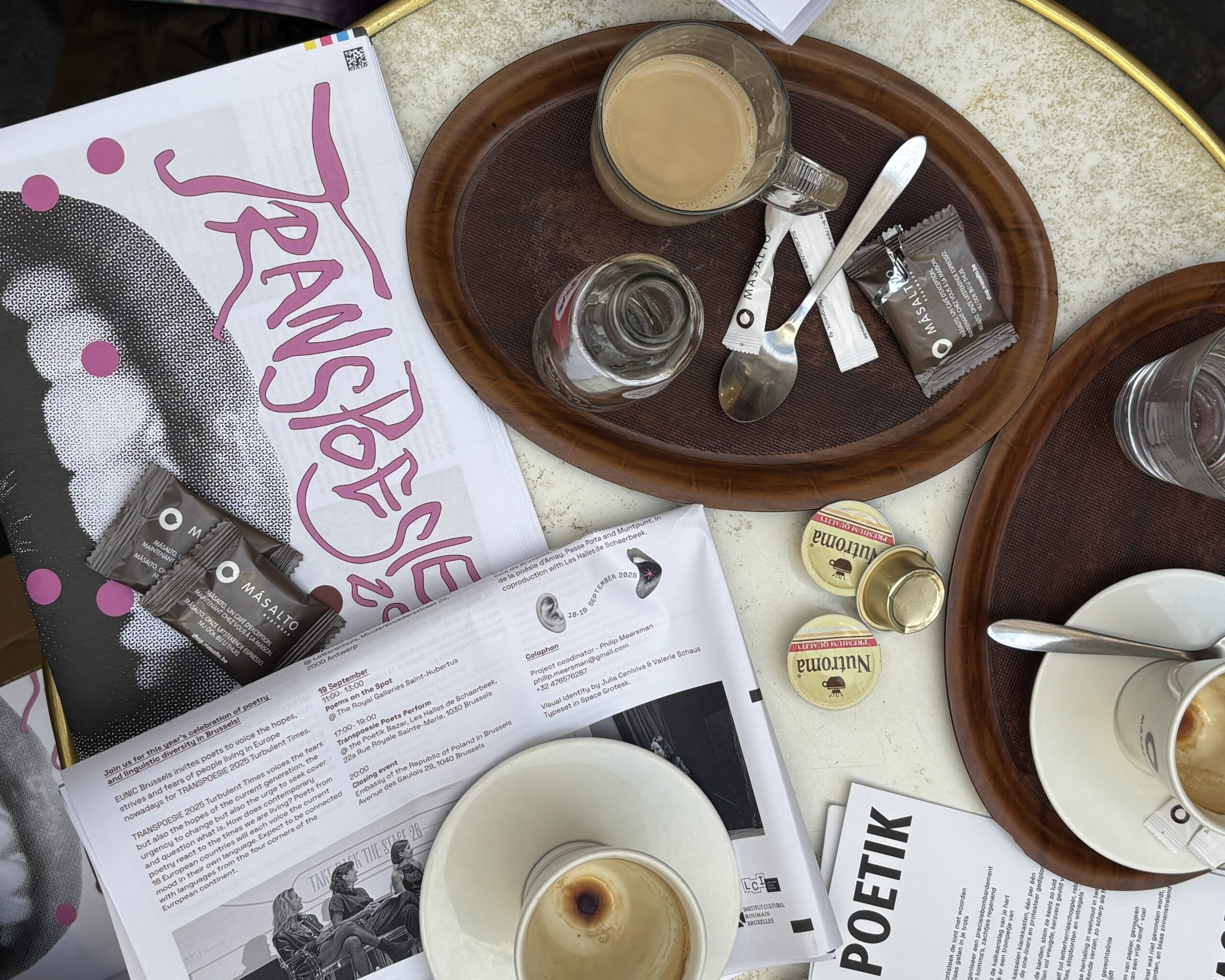
For poetry specifically, Transpoesie returns each September around the European Day of Languages: an international poetry festival organised by EUNIC Brussels since 2011, which brings poets from across Europe to Belgium to perform, translate, and exchange in their original language alongside French and Dutch translations. Transpoesie celebrates poetry as a meeting place between languages, territories, and cultures. The 2026 edition, titled “Where Voices Meet”, will be centred around translation. More information at passaporta.be, flb.be, and transpoesie.eu.
Honourable mentions: The Brussels Ass Book Fair – held annually in late November at KANAL-Centre Pompidou, a queer book fair dedicated to independent publishing; the BD Comic Strip Festival held in Brussels, end of September in 2026; and the annual WIELS Art Book Fair, held in October, a free weekend gathering of independent art publishers with talks, launches, and book signings.
All in all, this overview is not exhaustive, and the scene keeps moving. New spaces and collectives emerge regularly. But the density of what exists here, across languages, disciplines, and neighbourhoods, is the best argument against writing in isolation I have found. Suggestions and corrections are welcome.
May the city and its literary scene serve you well.
Cover image: Transpoesie 2025. Photo: Sofia Busatto.