
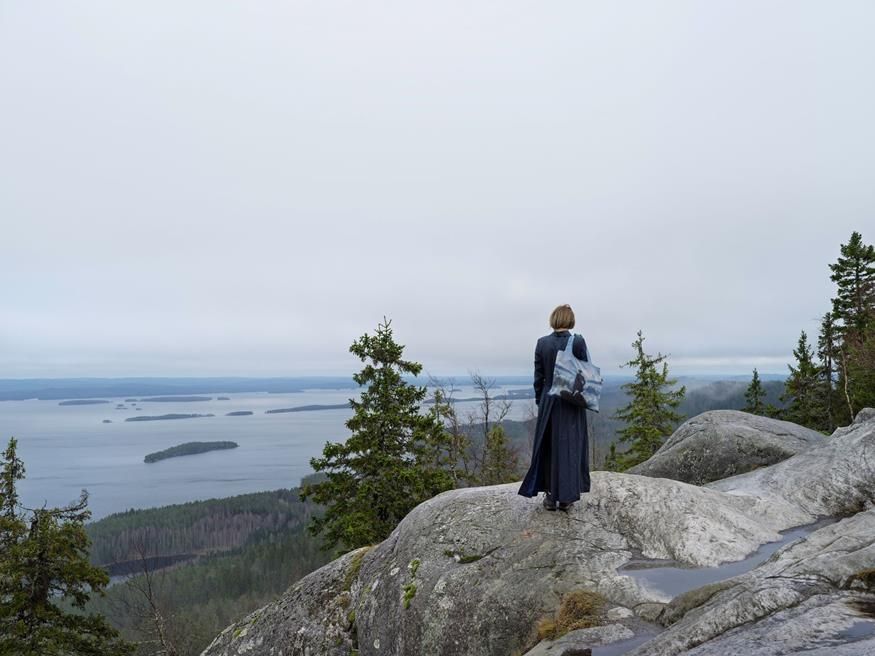
Over the years, we have had several opportunities to visit the European Parliament’s contemporary art collection. Following the acquisition of works by Inka Bell and Elina Brotherus, we wanted to know: how exactly does an art work end up inside the European Parliament? Our Programme Assistant Tilda Forss and Communications Assistant Margareeta Lauronen met up with Brussels-based curator and seconded national expert for the collection Jan Randáček to learn more about the process. In this blog post, Tilda explains how it all works.
How art works end up inside the European Parliament
To many’s delight and surprise, the European Parliament has an art collection. Founded in 1980 by Simone Veil, President of the first directly elected European Parliament and the first woman to hold office, it today contains almost 600 works from 400 artists, across 37 countries and every year new artwork is acquired and exhibited. But who decides on the acquisitions and how? Perhaps you are as intrigued as I was: how exactly does an art work end up inside the European Parliament? Let’s find out.
Not a museum
The European Parliament Contemporary art collection hangs inside the European Parliaments buildings in Brussels Strasbourg and Luxembourg, the Parliament’s liaison offices in the Member States, and in storage – simultaneously secluded and on display. We sat down with Brussels-based Jan Randáček, curator and seconded national expert for the collection, to learn more about it.
Jan makes an important distinction early on: “We are not a museum of art. We are an institution.” This means works hang in hallways, offices, and corridors, not in dedicated exhibition spaces, and the public only gets to see the exhibition when visiting the European Parliament. This shapes everything from acquisition strategy to exhibition philosophy.
Engaged art
When discussing the role of the collection and the recent acquisition Family by Estonian artist Edith Karlson – a series of sculptures depicting human figures with monster heads, made in response to a public debate in Estonia about family policies , – we come across a central question. Can art inside a political institution be apolitical?
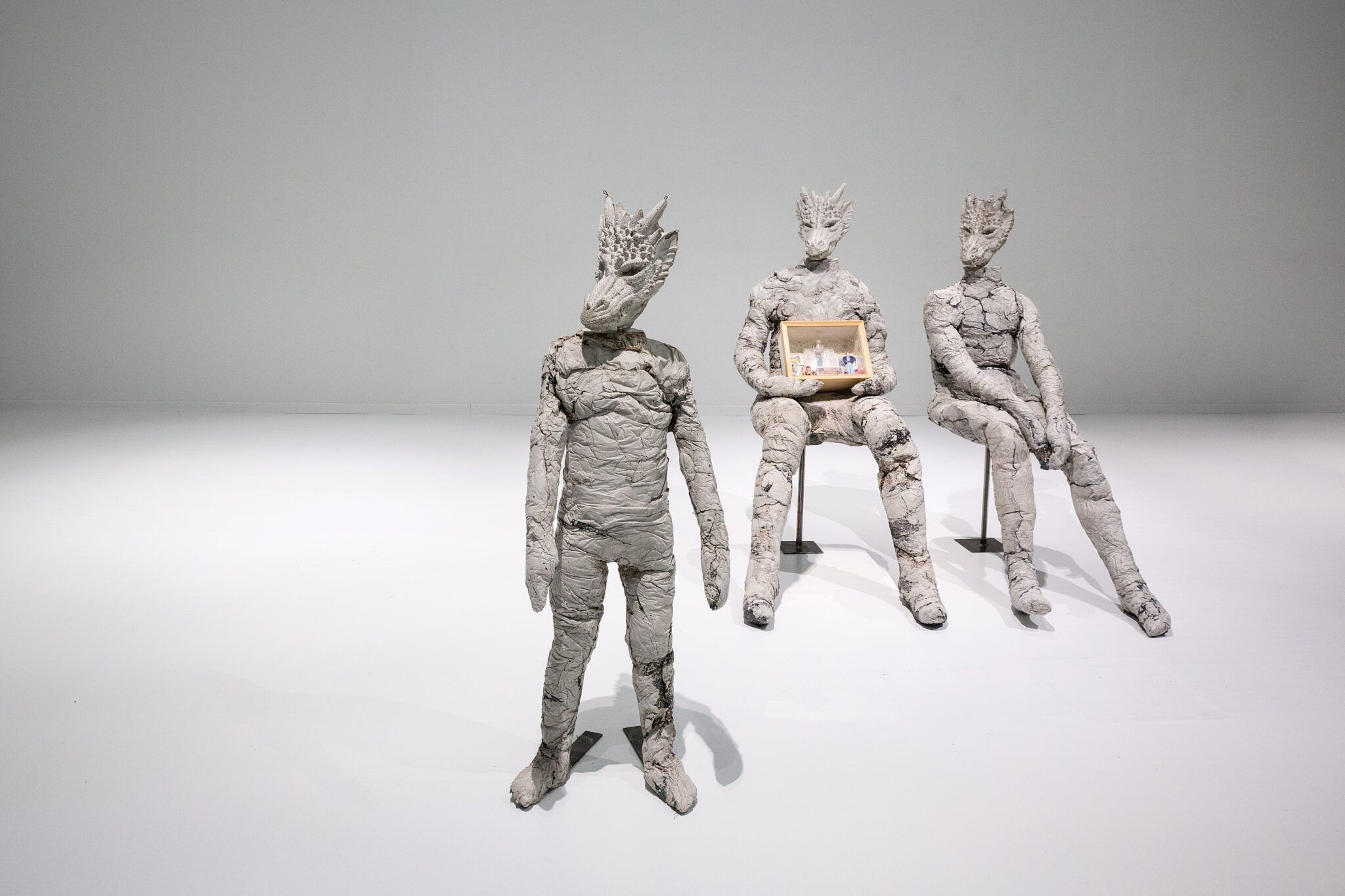
Edith Karlson’s sculptures Family. Photo by © Hedi Jaansoo and KUMU Art Museum.
Jan doesn’t shy away from answering. “Everything is political,” he says. At the same time, he resists reducing the collection to advocacy. The line the collection tries to draw is somewhere around the word offensive, which Jan acknowledges is difficult to define, especially when the setting the works are placed in are frequented by everyone from the far left to far right. “The borderlines are different for each of us, and what can be offensive for me doesn’t have to be offensive for you.” The answer, it seems, is not to avoid the difficult, but to be prepared to explain it. To the interestingly narrow-yet-wide target audience of school children, tourists, visitors, lobbyists, members of parliament, and more, the collection can, in Jan’s words, “open debates on social and political issues relevant to the Parliament’s legislative work”. In the face of controversy and contestation, this can be seen as a testament both to the communicative power of art and to the fact that the collection, just like the Parliament, remains very much alive. So, how does the collection concretely then go about growing? How does a work of art make it through the door? Well, the acquisition process has three steps.
Step 1: Identifying the countries
The process begins not with artists, but with gaps. Each year, four countries are selected for an acquisition round on the basis of which are underrepresented in the collection. Currently, large member states are notably thin on representation: Germany, France, Poland, and Spain all have fewer works than their size would suggest. Italy, Greece, and — in a post-Brexit quirk — the UK, on the other hand, are overrepresented. (The collection’s single most expensive work is by Peter Doig, who remains on the walls despite Britain’s departure from the EU). Finland is, by population and size, with eleven works in the collection, well represented. Overall, the collection has also always favoured younger creators from their selected countries: those with solid exhibition records both domestically and abroad, and some critical literature behind them – not necessarily the big institutional artists. Jan jokes that the budget doesn’t allow for them to buy the big names; a blessing in disguise and something which has led to them championing fantastic mid-career artists.
Since 2019–2020, the acquisition rules have added a further filter: all purchased works must be by female artists, a deliberate corrective since women represented only around 20% of the collection at the time. This was also what prompted the 2022–2023 Art Herstory exhibition. The figure has since risen to roughly 27–28%.
In total, there are many balances that the collection is trying to maintain: gender, age, and geography, as well as a mindfulness to the breadth of artistic mediums. Works on paper, photography, painting, and drawing remain more practical than sound, light, or video installation. That’s why they need help from the local experts.
Step 2: The EPLO longlists
Once the annual four countries are identified, the European Parliament Liaison Offices (EPLOs) in each capital are contacted. These offices consult with local independent curators, national galleries, ministries of culture, and universities to compile a longlist of female artists and artworks. The criteria are simple: the artists should work with contemporary techniques and explore themes that resonate with European values. It is at this stage that the process touches ground.
The 2023 Acquisitions Programme included works from Austria, Bulgaria, Croatia, and Finland, and the themes prioritised included identity, memory, ecology, sustainability, democracy, and migration. Hannariikka Nieminen from the EP Liaison Office in Helsinki describes what the 2023 Finnish acquisition round looked like in practice:
“The selection and acquisition of works by Finnish female artists was a specific cultural highlight of 2023/2024 for the Liaison Office in Helsinki. This was a rather out-of-the-ordinary exercise for us EU communicators, despite culture and its promotion being within the Union’s remit. That’s why Frame Contemporary Art Finland, and notably Head of Communications Rosa Kuosmanen‘s kind and valuable expertise, was pivotal for our preselection. Frame identified and contacted potentially suitable and renowned artists, inviting them to propose works for the acquisition. And they did: we got a selection of fantastic paintings, photographs, installations, sculptures, and paper sculptures to propose for the Parliament’s artistic committee.”
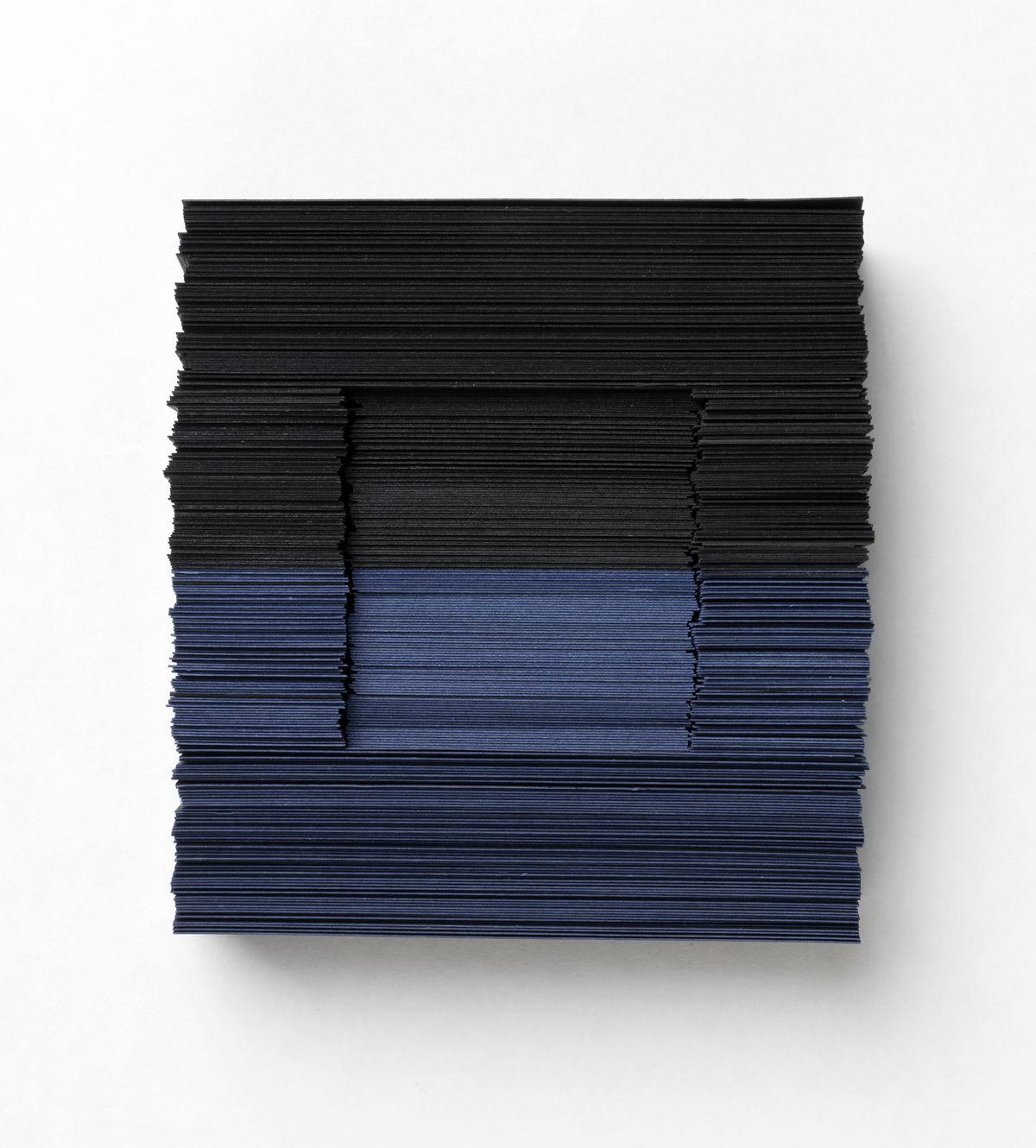
Inka Bell’s paper sculpture 01:14, 2018. Photo by © Paavo Lehtonen.
Step 3: The artistic committee, the Quaestors, and the president’s approval
The liaison offices then suggest names for the collection. From the EPLO longlists, Jan’s team in Brussels prepares an internal preselection. In 2023, two Finnish works were pre-selected (and eventually chosen). The first was Wanderlust, Elina Brotherus’ feminist photographic reinterpretation of Caspar David Friedrich’s painting Wanderer above the Sea of Fog (1818), à la Cindy Sherman’s series History Portraits. The second was Inka Bell’s minimalistic and layered paper sculpture, entitled 01:14. Jan’s team prepared an accompanying dossier for each proposed work, and the preselection went to the Artistic Committee, a political body of three MEPs currently chaired by Quaestor Miriam Lexmann, for approval.
Quaestor Lexmann herself especially acknowledges the acquisitions’ current feminist scope, noting that recently bought works “have resonated with major societal themes of today and placed a stronger emphasis on modern and contemporary expressions.”
At this stage, the Committee can request explanations, suggest changes, or simply sign off. “As far as I remember,” Jan says, “there were very few changes to our preselection.” Once the Committee approves the preselection, it passes to the Quaestors. They, in turn, pass the preselection to the President of the European Parliament, whose signature is the final green light. Only then does Jan’s team contact the artists, liaising on descriptions, images, and the logistics of getting the works from their studios to Brussels.
What’s next for the collection? Water and an anniversary
The presidency exhibition model, which has paired works from the collection with loans from whichever country holds the EU Council Presidency, is being wound down after Ireland’s turn in 2026, in favour of thematic shows tied more directly to the Parliament’s legislative agenda. Whether that shift narrows or deepens the collection’s reach remains to be seen. The first of these thematic exhibitions is the upcoming “Currents of Europe”, centred on water, opening in Strasbourg in July 2026 before moving to Brussels in January 2027.
The exhibition will draw entirely from existing works in the collection, organised around four strands: water in its natural state; water as joy; water quality; and water under threat from industrialisation and plastic. Elina Brotherus’ photograph, featuring the archipelagic Finnish landscape, will be included. Much of these themes tracks closely with legislation the Parliament has already discussed and passed. “There’s always a pedagogic approach,” Jan explains, “that makes it easier for teachers to use an artwork as an opener, to allow a discussion.”
Looking further ahead, the collection turns 50 in 2030. Jan’s team is already in conversation with Brussels museums about marking the occasion with a public exhibition. “We don’t need big, but we of course wouldn’t say no to it either,” he says. “Most importantly, we just want to capture this historic moment and show the hidden treasures of the European Parliament to the public.” The anniversary matters as both record and tribute: a record of the EU’s enlargements, crises, and continuities refracted through art, and a tribute to the founding gesture. Simone Veil’s rationale for establishing the collection in 1980 was simple: we need to know where we come from to know where we are going.
So: how does an artwork end up inside the European Parliament? Through a process that is considered, a bit bureaucratic, and, as of now, no longer a mystery.
Guided tours of the collection can be booked through the Parliament’s visitor services, with new dates regularly published. The full collection can be explored online, its website is translated into all 24 official EU languages. And every Monday, the team posts on Pinterest, linking a work from the collection to a piece of EU legislation – a small, weekly reminder that the collection is alive and paying attention. At the current rate, there are enough works to sustain this for a decade without repetition.
View the European Parliament Contemporary Art Collection in full at art-collection.europarl.europa.eu.
Cover image: Elina Brotherus’ photograph Wanderlust, 2020. Photo courtesy of the European Parliament Contemporary Art Collection.