
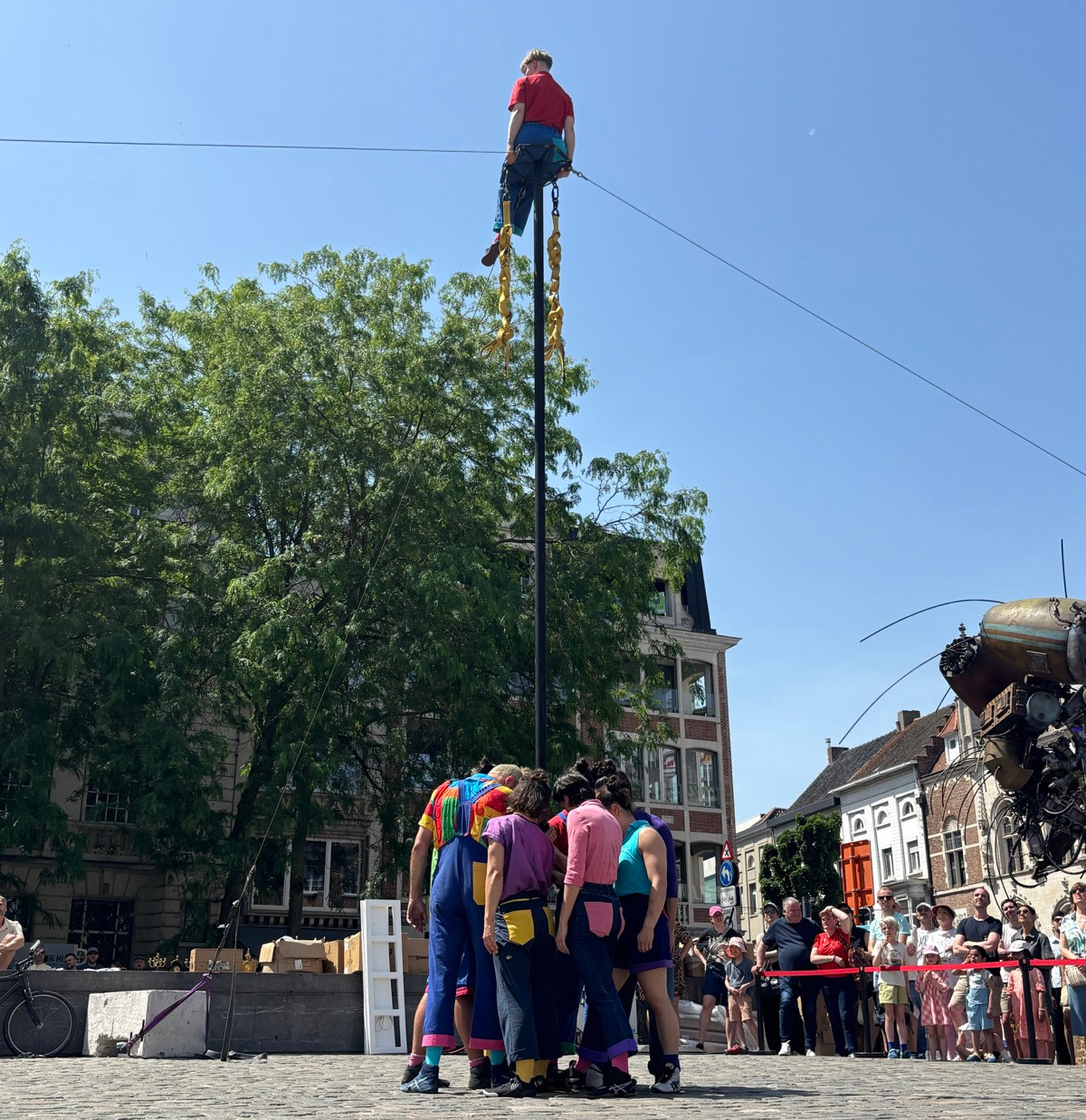
Each spring, Belgium turns into a stage for circus. From outdoor street festivals to studio showcases, a wave of events across the country invites artists and audiences to ask what contemporary circus can be, and who gets to be seen doing it. Our Communications Assistant and circus researcher and teacher, Margareeta Lauronen, shares her experiences of the circus scene in Belgium, reflecting on representation in the field while giving an overview of the year’s festival lineup, from Brussels to Leuven to Kortrijk.
A glimpse into the circus scene in Belgium
Small hands tightly grasp a red chiffon scarf. We are at the Finnish Seamen’s Mission in Brussels, and the second weekend of our children’s circus days is underway. Alongside my internship at the Institute, I organised circus days for children, inspired by my conviction that circus offers a unique combination of artistic expression, creativity, and community engagement. During the first weekend, participants ranged from three to twelve years old. The second was dedicated to family groups with children under the age of three.
Demand is high. Every workshop filled quickly, and one family asked whether their three-month-old baby could participate. I welcomed participants with the gentle suggestion that it would be helpful if the child can hold up their own head. Beyond that, circus is for everyone, regardless of age, body, gender, or social background. Or at least, that is how it should be.
Who gets to be seen
As part of my theatre studies, I have examined questions of embodiment and representation within contemporary circus. In both my bachelor’s and master’s theses, I explored the representation of women and female-presenting performers on contemporary circus stages in an international context. I also investigated the gender distribution among graduates of higher circus education institutions and considered why men continue to form the majority of graduates, despite women and girls representing a large proportion of participants at recreational and youth circus levels. Equally important was the question of where artists outside the gender binary fit within this landscape.
While these studies cannot provide definitive answers, they offer insight into which bodies and identities have been granted visibility within the circus field in recent years. Contemporary circus in Europe remains highly gendered and predominantly white, both on stage and behind the scenes. The roles available to female-presenting performers often mirror traditional circus archetypes and offer limited agency. As a circus teacher, I want every person who enters a circus space to feel that there is a space for them, that they belong, both on stage and backstage.
Where to find circus in Belgium
As a hotspot for the performing arts, the Benelux region hosts an enormous range of performances both in public spaces and beneath the surface, blending dance, theatre, circus, cabaret and other artistic practices. International festivals stretch the boundaries of urban space, invite diverse audiences to engage with circus, and explore the limits of gender, generations, and social structures. The list is by no means exhaustive.
The festival season begins in March with the biennial UP Festival, which transforms the Brussels’ Molenbeek district into a playground for the performing arts through circus tents, theatre stages, site-specific installations, and circus performances. The festival views “the city as a stage, the audience as an active partner, and circus as a major art form for thinking, feeling, and inhabiting the world differently.”
In early April, the large-scale street arts festival De Gevleugelde Stad Ieper takes over the streets, parks, and squares of Ypres. Functioning as an international showcase for street arts, the festival brings together circus artists, puppeteers, musicians, fire performers, dancers, and theatre makers. Its three-day programme is entirely free of charge.
Throughout the year, MAD Festival organises artist residencies and masterclasses for circus practitioners. Its annual festival, held in late April, provides a platform for emerging artists to present their work at the beginning of their professional careers.
Since 2016, the circus and street arts centre Latitude 50 has organised FAR de Huy – Festival des Arts de la Rue, one of Belgium’s major street circus festivals. The 2026 edition featured nearly one hundred performances by thirty-three Belgian and international companies, including world premieres, Belgian premieres, and works developed through the centre’s residency programme. This festival is also free to attend. Latitude 50 is also a partner in Festival Moments de Cirque, held annually in Namur and Liège. In 2026 the festival takes place from 25 September to 10 October.
Both Hopla! and Sortilèges, Rue et Vous! flow through urban spaces, bringing performances to a variety of locations. A particularly notable feature of Hopla! has been its Young Programmers initiative, launched in 2024, in which a group of young residents from the Versailles neighbourhood in Neder-Over-Heembeek curate a performance as part of the festival programme.
Sortilèges, Rue et Vous! also provides a platform for new creators. Each year, the festival opens a call for emerging artists whose productions are either still in development or about to premiere.
In early May, CIRKL presents five days of contemporary circus performances in Leuven. Alongside internationally recognised productions, the programme showcases new and experimental works by artists who have spent the previous year in CIRKLABO residency.
The street arts festival Sinksen in Kortrijk annually fills the city with circus, dance, theatre, and music. In 2026, the festival also featured Prologue, a work created by graduating students from ESAC, the only college in Belgium that offers official training in the field. Throughout the spring, ESAC hosts showcase evenings featuring works by students from different year groups presenting their creations. The spring season culminates in the graduation performances presented as part of the EXIT programme, typically around mid-June.
As spring turns into summer, Miramiro Summer Festival takes place in July in Ghent. Built around creations developed within the Miramiro workspace, the festival provides a platform for contemporary circus artists from Belgium and abroad.
Looking at Belgium’s festival landscape, it is clear that opportunities for diverse and varied representations and roles do exist. Whether this potential is realised in practice, and whether audiences can see it, can only be discovered by experiencing the performances themselves. Perhaps next spring I will join audiences across Belgium’s festival circuit, gathering research material that may contribute to ongoing discussions on how to foster a more diverse and inclusive circus sector. A sector that reflects a greater diversity of bodies, identities, and representations.
I believe audiences are ready for this. Hopefully, the curators, admissions panels, directors, and casting professionals who shape the future of the circus field are ready as well, from the earliest stages of circus education to the world’s largest professional productions.
Cover image: Prologue performed by Soif Totale at Sinksen 2026, Kortrijk. Photo by Margareeta Lauronen.